
Unlock Your Potential: Become Aware of Your Automatic Mental Patterns Through Mental Fitness Coaching

Updated: Dec 8, 2025
Have you ever caught yourself thinking, “I’m not good enough,” “I’ll never get this right,” or “I have to please everyone or they’ll leave”—before realising those thoughts were just running on autopilot?
These mental patterns don’t come out of nowhere. They’re shaped by past experiences, wired into your nervous system, and reinforced over time. But here’s the good news: they are not permanent. The encouraging truth? These patterns are not fixed.
Thanks to neuroplasticity—the brain’s ability to rewire itself through experience—you can train your mind and nervous system to move from survival mode to self-leadership, calm, and confidence (Doidge, 2007; Siegel, 2012).
With the right awareness and support, you can rewire your mind/brain and unlock the version of you that’s calm, clear, confident, and resilient.
What Is Mental Fitness Coaching?
Mental Fitness Coaching is a neuroscience-based approach designed to strengthen emotional resilience, rewire unhelpful thought loops, and foster a calm, focused, and compassionate mindset.
It builds on the work of Shirzad Chamine’s Positive Intelligence framework (2012), which integrates cognitive-behavioral techniques, mindfulness, and positive psychology to identify and weaken the mind’s “saboteurs”—the automatic, self-defeating thoughts that drain your energy and confidence.
Common saboteurs include:
The Judge – constant self-criticism or judgment of others
The Pleaser – seeking validation through helping others
The Hyper-Achiever – tying self-worth to performance
The Avoider – numbing or procrastinating in the face of discomfort
The Controller – over-managing to avoid uncertainty
By developing awareness of these patterns, you begin to reclaim the neural “real estate” they occupy and strengthen what Chamine calls your “Sage” mindset—your wise, grounded, emotionally intelligent self.
Try it: Take the free, research-based Saboteur Assessment to identify your top mental saboteurs.
You’ll receive a customised report showing which patterns dominate your thinking—and how they may be limiting your potential.
Why Mental Fitness Matters
Just as physical exercise strengthens muscles, mental fitness strengthens your brain’s capacity for regulation, focus, and flexibility.Repeated practice—of mindfulness, cognitive reframing, and self-compassion—literally changes the brain’s structure and chemistry (Davidson & McEwen, 2012).
Building mental fitness helps you:
Reduce chronic stress and emotional reactivity (Thayer & Lane, 2000)
Regulate your nervous system and enhance vagal tone (Porges, 2011)
Improve decision-making and concentration (Lazar et al., 2005)
Strengthen empathy and relationships (Fredrickson, 2013)
Cultivate lasting calm, clarity, and self-trust
This isn’t just mindset coaching—it’s nervous system and neuroplasticity training. You’re teaching your brain and body new pathways for safety, focus, and connection.
Step by Step: How It Works
Awareness – Identify your saboteur thought loops and triggers. Interruption – Use somatic and cognitive tools to pause reactivity. Rewiring – Strengthen new neural patterns through repetition, compassion, and curiosity. Integration – Align mind, body, and behavior for calm, confident action.
Over time, the combination of mindfulness, emotional regulation, and deliberate neural training builds what neuroscientists call neurovisceral integration—a harmonious dialogue between your brain, heart, and body (Thayer & Lane, 2009).
The Takeaway
Your thoughts are not your identity—they’re learned habits of the nervous system. With guidance and practice, you can retrain your inner dialogue to become your greatest ally, not your harshest critic.
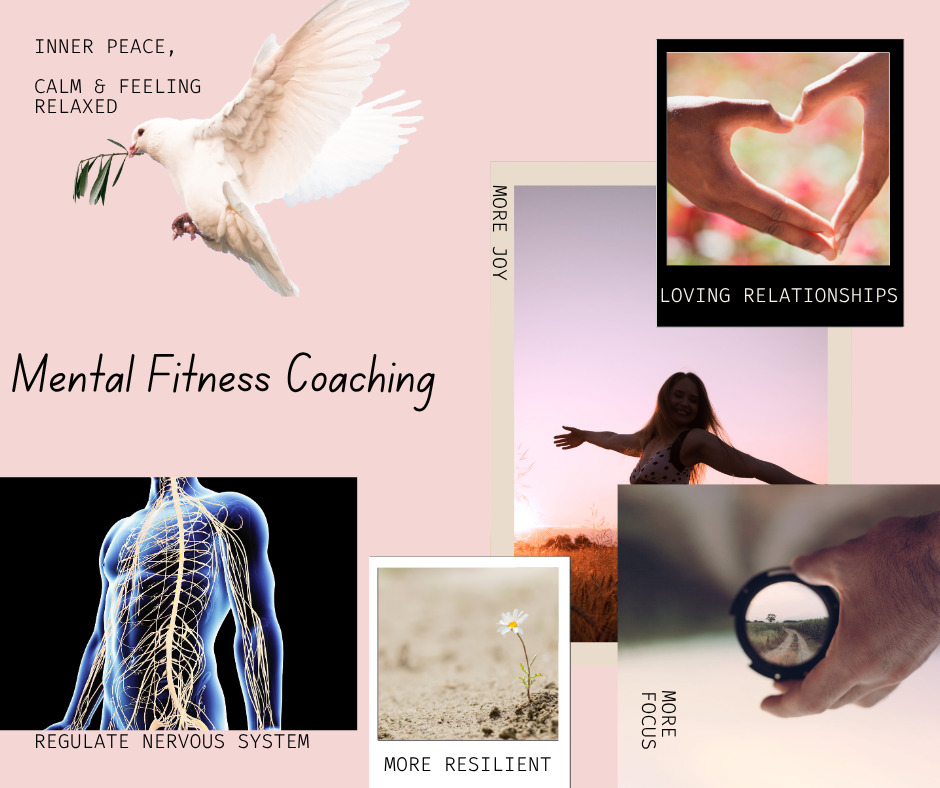
Through Mental Fitness Coaching, you’ll strengthen your mind’s “muscles” for focus, resilience, and joy—and experience what it truly feels like to lead your life from the inside out.
This isn’t just mindset coaching—it’s nervous system and neuroplasticity training.
References
Chamine, S. (2012). Positive Intelligence. Greenleaf Book Group Press.
Davidson, R. J., & McEwen, B. S. (2012). Social influences on neuroplasticity: Stress and interventions to promote well-being. Nature Neuroscience, 15(5), 689–695.
Doidge, N. (2007). The Brain That Changes Itself. Penguin.
Fredrickson, B. L. (2013). Positive emotions broaden and build resources. Advances in Experimental Social Psychology.
Lazar, S. W. et al. (2005). Meditation experience is associated with increased cortical thickness. NeuroReport.
Porges, S. W. (2011). The Polyvagal Theory: Neurophysiological Foundations of Emotions, Attachment, Communication, and Self-Regulation. Norton.
Siegel, D. J. (2012). The Developing Mind (2nd ed.). Guilford Press.
Thayer, J. F., & Lane, R. D. (2000, 2009). A model of neurovisceral integration in emotion regulation. Journal of Affective Disorders.


Comments